Regulatory Guide: Companies' Obligations Regarding Carbon Footprints
Who is required to calculate, publish, record, or report their carbon footprint under applicable Spanish, European, and regional regulations. An updated practical guide for companies, SME suppliers, and the public sector. Updated as of June 2026 -
Important Notice
This guide is intended for informational and educational purposes. Regulations regarding sustainability, carbon footprints, corporate disclosure, and public procurement are evolving rapidly, particularly due to changes resulting from the CSRD, the ESRS, and the European regulatory simplification package, as well as legislative and procedural changes at MITECO. Therefore, before making any legal, corporate, or reporting decisions, each company should verify its specific situation by seeking specialized advice.
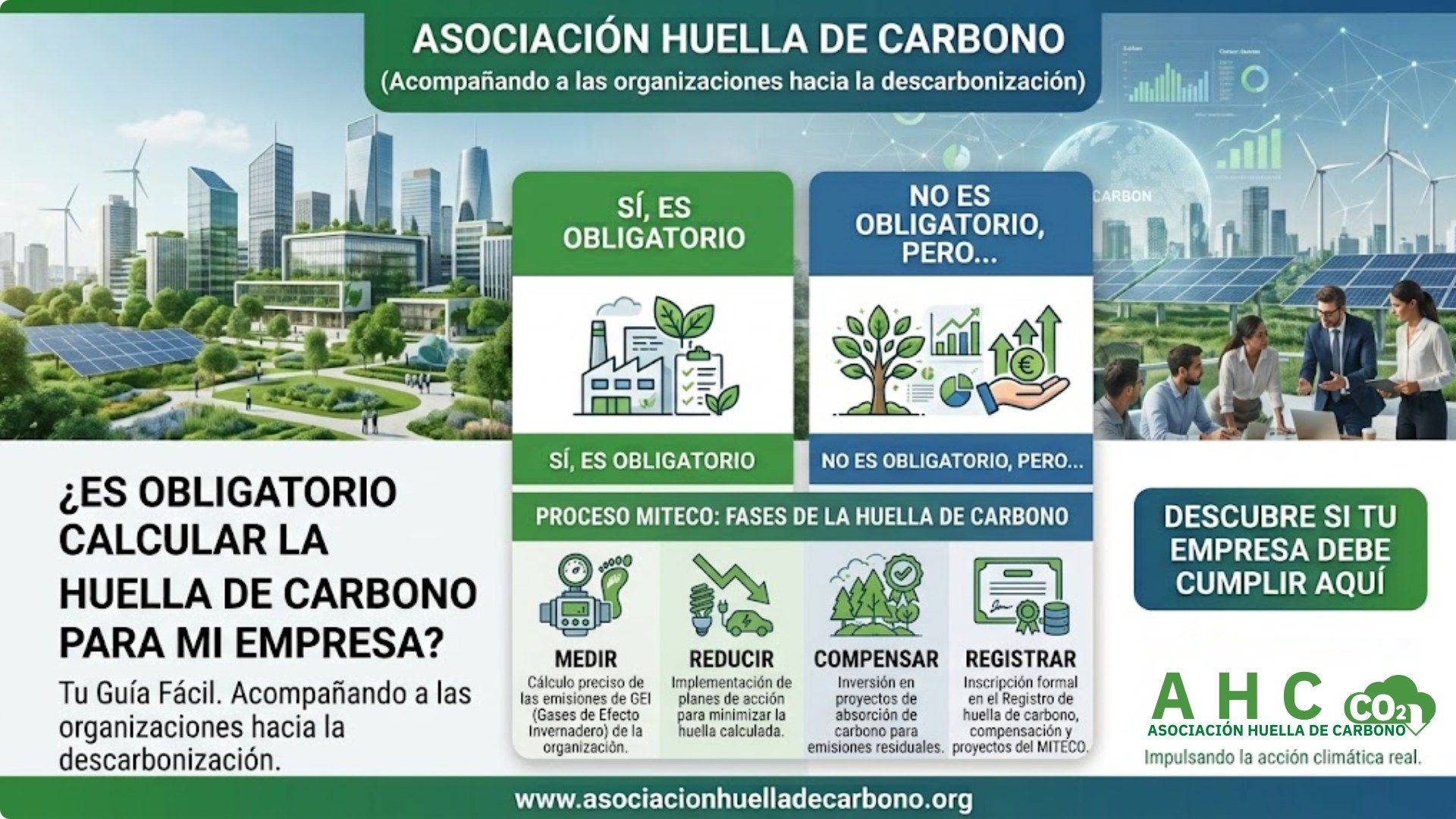
Is a company legally required to calculate its carbon footprint, or might it be required to do so for business reasons, or is it in its best interest to take the initiative to improve its competitiveness, access to contracts, and climate credibility?
It depends on the type of company, its size, its legal structure, whether it is subject to sustainability reporting requirements, and whether it operates in sectors or regions with specific regulations.
In Spain, certain companies are required to calculate and publish their carbon footprint and to develop and publish an emissions reduction plan. This requirement stems from Law 7/2021 on climate change and the energy transition and has been implemented by Royal Decree 214/2025.
However, it is important to distinguish between calculating the carbon footprint, publishing the information, developing a reduction plan, and registering with the MITECO Registry. For private companies subject to these requirements, registration with the MITECO Registry is generally voluntary. The primary obligation is to calculate the carbon footprint, publish the corresponding information, and have a reduction plan in place in accordance with applicable regulations.
Furthermore, although many small and medium-sized enterprises (SMEs) are not directly required by law to calculate their carbon footprint, they may be indirectly affected by demands from customers, public tenders, financial institutions, grants, supplier certifications, or supply chain requirements from large companies subject to sustainability reporting.
For many organizations, the transition to a decarbonized economy is no longer a purely voluntary matter.
For certain companies, large corporations, and public entities, regulations already require them to calculate their carbon footprint, publish climate-related information, or implement reduction plans.
In other cases, particularly for SME suppliers, the requirement may stem from customers, competitive bids, banks, grants, or certification processes.
Therefore, it is important to distinguish between three situations: direct legal obligation, indirect market requirement, and voluntary strategic decision. This distinction prevents confusion among companies and allows for proper guidance in each case.
Difference between a direct legal obligation, an indirect requirement, and a voluntary calculation
Not all companies are in the same situation. To correctly interpret carbon footprint regulations, it is helpful to distinguish between three scenarios:
1. Direct legal obligation: This exists when a regulation applicable to the company itself requires it to calculate and publish its carbon footprint, develop a reduction plan, or include climate-related information in its sustainability report.
2. Indirect market requirement: This occurs when a company is not directly required by law to do so, but a customer, government agency, financial institution, large company, certification body, grant provider, or public procurement process requests information about its emissions.
3. Strategic voluntary calculation: This occurs when an organization decides to calculate its carbon footprint even though it is not required to do so, in order to understand its emissions, reduce costs, improve its reputation, prepare for bids, gain access to more demanding customers, or anticipate future obligations.
This distinction is essential to avoid mistakes. Many small and medium-sized businesses are not directly required to calculate their carbon footprint, but they may need to do so for business or competitive reasons.
1. The European Framework: The European Green Deal’s Climate Targets for 2030, 2040, and 2050
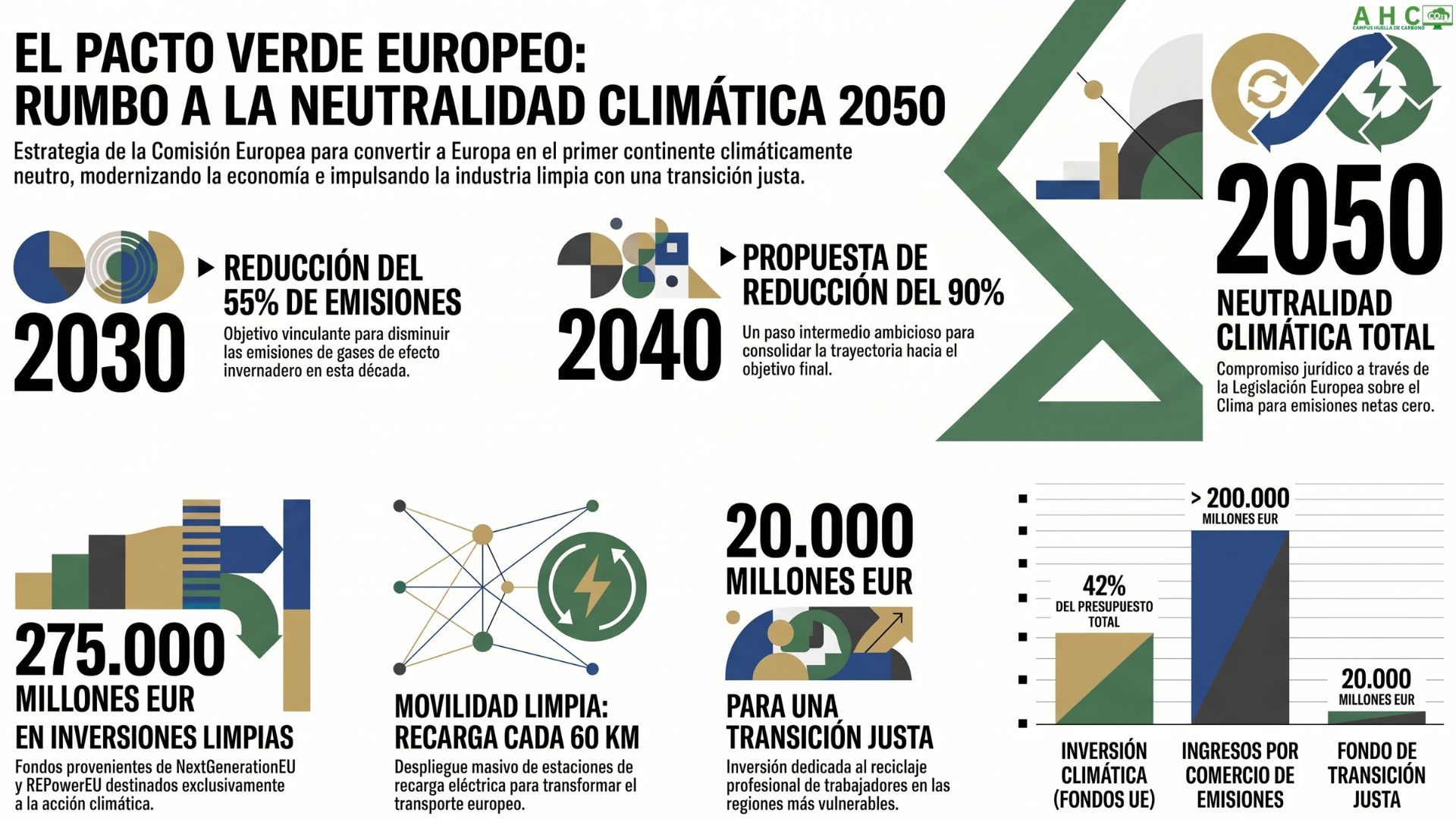
All national legislation stems from the commitments made by the European Union to combat the climate emergency. The European Climate Law (Regulation (EU) 2021/1119) sets legally binding targets:
- 2030 Target ("Fit for 55" Package): A reduction of at least 55% in net GHG emissions compared to 1990 levels.
- 2040 Goal: Proposal for an intermediate net reduction target of 90% compared to 1990.
- 2050 Goal (European Green Deal): Achieve climate neutrality (Net Zero Emissions).
The European Green Deal is not just an environmental regulatory framework; it is the new paradigm for global industrial competitiveness and resilience.
2. Who is required to calculate and publish their carbon footprint in Spain?
In Spain, the government's requirement to calculate and publish carbon footprints does not apply across the board to all companies.
Royal Decree 214/2025 specifies the provisions applicable to all companies already subject to certain sustainability or non-financial reporting obligations, under the terms set forth in the Commercial Code, the Capital Companies Act, Law 11/2018 and its amendments, or any regulations that may replace them.
Royal Decree 214/2025 itself clarifies that it does not expand the group of companies required to calculate their carbon footprint or establish a reduction plan beyond those already covered by that corporate disclosure framework. Therefore, before determining that a company is subject to these requirements, one must review its size, legal structure, group affiliation, status as a public-interest entity, obligation to prepare a sustainability report or non-financial information statement, and applicable timeline.
For private companies subject to this requirement, registration with the MITECO Registry is voluntary. However, it may be advisable if the company wishes to obtain the official seal, strengthen the traceability of its calculations, improve its standing with clients, or provide evidence in connection with bids, sustainable financing, or certification processes.
Mandatory Criteria (Size, Revenue, and Capital)
As a general guideline, the non-financial and sustainability reporting framework has used criteria such as size, revenue, assets, public interest status, public listing, and group affiliation to determine which companies are required to report environmental and climate information. In many cases, these criteria have been linked to meeting at least two thresholds for two consecutive fiscal years, although the specific timeline and scope must be reviewed on a case-by-case basis in accordance with current regulations.
| Criterion | Threshold (Law 11/2018 and the CSRD Directive) |
|---|---|
| Average headcount | More than 250 employees. |
| Revenue | Over 40 million euros. |
| Total assets | More than 20 million euros. |
Note on CSRD: The CSRD has expanded the European framework for sustainability reporting and requires companies within its scope to report in accordance with the European Sustainability Reporting Standards. However, the timeline and scope of application are subject to recent European regulatory simplification measures. Therefore, it is advisable to verify each case based on the regulations in effect at the time of reporting, especially for companies that are not part of the first wave of implementation.
Furthermore, depending on the requirements in each sector, to determine whether a company should calculate and publish its carbon footprint, it is not enough to look at a single piece of data in isolation. The following elements, among others, must be reviewed:
| Item to Review | Why it matters |
|---|---|
| Average number of employees | This can determine whether the company is subject to sustainability or non-financial reporting requirements. |
| Turnover | It is one of the standard criteria used to define large companies or groups subject to certain obligations. |
| Total Assets | This may influence the company's classification within the corporate reporting framework. |
| Affiliation with a business group | Certain obligations apply on a consolidated basis. |
| Public Interest Entity Status | It may trigger specific obligations. |
| Listing on Regulated Markets | This may affect the timing and scope of sustainability disclosures. |
| Applicable regional regulations | Some autonomous communities have their own registries or requirements. |
| Relationships with major clients or the public sector | This may give rise to indirect requirements even if there is no direct legal obligation. |
As a general guideline, government requirements primarily affect large companies, certain business groups, and entities subject to sustainability or non-financial reporting requirements.
For unlisted small and medium-sized enterprises, a direct legal obligation is not usually the general rule, although commercial, financial, or public procurement requirements may apply.
Obligations under Law 7/2021 and Royal Decree 214/2025
Article 13.7 of Law 7/2021 establishes that companies are generally required to:
Article 13.7 of Law 7/2021 stipulates that the government must determine the types of companies operating in Spain that are required to calculate and publish their carbon footprint, as well as the frequency and the necessary elements for fulfilling this obligation. It also stipulates that companies subject to this requirement must develop and publish a plan to reduce greenhouse gas emissions.
Royal Decree 214/2025 implements this provision and specifies the current framework.
- For the affected private companies, the requirement is to calculate their carbon footprint, develop a reduction plan, and publish the relevant information.
- Registration in the MITECO Registry is voluntary for these companies, although it may be requested if the organization wishes to enhance its recognition and traceability.
- The reduction plan must include a quantified reduction target over a five-year time frame, along with the measures planned to achieve it.
- Emissions offsetting remains voluntary.
Updates to Royal Decree 214/2025 on Calculation, Publication, Registration, and Reduction Plans
Royal Decree 214/2025 updates Spain’s framework for carbon footprints, offsets, and carbon removal projects. It replaces the previous Royal Decree 163/2014 and establishes a more comprehensive framework for calculation, voluntary or mandatory registration (as applicable), offsetting, and carbon removal projects.
Among its main new features are the following:
1. Difference between calculation, publication, and registration.
Private companies subject to these requirements must calculate their carbon footprint, develop a reduction plan, and publish the relevant information. However, they are not required to register with the MITECO Registry. Registration is voluntary for them.
2. Reduction plans with a minimum horizon of five years.
The reduction plan must include a quantified emissions reduction target over a five-year time horizon , along with the measures planned to achieve it. For example, a plan for 2026-2030 with a baseline year of 2025. These targets must be formulated in a manner consistent with applicable climate commitments, the Paris Agreement, and the European pathway to climate neutrality by 2050, to the extent required by the relevant regulations and reporting framework.
3. Minimum scope for the registration of organizational footprints.
When an organization registers its organizational carbon footprint in the MITECO Registry, the registration includes, at a minimum, Scope 1 and Scope 2 emissions. Scope 1 includes direct emissions generally related to fossil fuels, and Scope 2 includes indirect emissions associated with electricity and energy purchased and consumed by the organization. See the specific case for public institutions at the end of this document.
4. Emission factors and supporting documentation.
The calculation must be based on the emission factors and technical documents (calculators, guides, examples) published by the Ministry for Ecological Transition and the Demographic Challenge, through the Spanish Office for Climate Change, to facilitate the comparability and traceability of the calculations.
5. State Public Sector.
Certain entities in the state administrative public sector must calculate their carbon footprint, develop a reduction plan, and submit the information annually to the MITECO Registry. The first submission will take place in 2026 and will cover the carbon footprint for the year 2025.
6. Public procurement.
Royal Decree 214/2025 strengthens the possibility of incorporating the carbon footprint into public procurement as an environmental criterion, a technical specification, a special performance condition, or an evaluation factor, provided that the relevant tender documents provide for it and public procurement regulations are complied with.
As a result, in certain competitive bids, companies that do not have sufficient environmental information may be at a disadvantage when the bid specifications explicitly require this type of evidence.
7. External verification.
External verification is not always mandatory when calculating a carbon footprint. It may be necessary or recommended depending on the type of organization, the scope of the assessment, the intended use of the information, and the requirements for registration, certification, bidding, funding, or sustainability reporting.
External verification criteria: It is important to clarify that external verification by a third party does not It is required by default for the calculation, unless the organization decides to voluntarily register that carbon footprint in the official MITECO registry and is an SME or includes Scope 3 in its registry. For all others (non-SMEs and Scope 1+2, external verification is not required).
8. Electronic Processing.
Applications for registration or updates to the MITECO Registry must be submitted using the forms and electronic channels provided by the Ministry. Submissions via email to the OECC are no longer permitted.
Legal and Operational Summary
Requirements under the Climate Change Act and CSRD regulations (see details on a case-by-case basis)
Large Companies
- Over 250 employees.
- +40M€ Revenue.
- +20M€ Assets
Suppliers
- Scope 3 Requirement.
- General Guidelines for the Certification of Large and Public Companies
Public Sector
- It can be incorporated as an environmental criterion, a special implementation condition, a technical requirement, etc.
| Detailed Organization Type | Most common situation |
|---|---|
| Large companies and groups subject to sustainability reporting or non-financial reporting requirements | They may be required to calculate and publish their carbon footprint and to develop a reduction plan. Registration with MITECO is voluntary for private companies. |
| Unlisted SMEs | Generally, they are not directly required by the federal government to calculate their carbon footprint, unless applicable regional, sector-specific, or contractual regulations require it. It may be advisable to do so for market, customer, financing, or bidding purposes. |
| Suppliers to large companies | They may receive requests for emissions data, particularly when their customers are required to report on the value chain or Scope 3 emissions. This should not be presented as an automatic legal obligation for all suppliers. |
| Companies that bid on public sector contracts | The carbon footprint may appear in bid documents as an environmental criterion, a special condition, or a technical requirement, depending on the contract. It is advisable to review each bid. |
| Affected State Public Sector | It must calculate its carbon footprint, develop a reduction plan, and register annually with the MITECO Registry starting in 2026, using data from 2025. |
| Autonomous communities, provincial councils, and local governments | They may have their own obligations or records in accordance with regional regulations. They may also voluntarily apply similar criteria. |
3. Suppliers and the Value Chain: The Indirect Impact on SMEs
Although many small and medium-sized enterprises (SMEs) are not directly required by federal regulations to calculate their carbon footprint, an increasing number of suppliers are receiving requests for environmental information from their customers, especially when those customers are large companies subject to sustainability reporting requirements (CSRD/ESRS), ESG policies, sustainable financing, or climate commitments.
In these cases, the requirement does not always stem directly from a law applicable to SMEs, but rather from their customers’ need to better understand the emissions associated with their value chain. For this reason, an SME may need carbon footprint data to maintain certification, complete a supplier questionnaire, participate in a bidding process, access financing, or demonstrate environmental improvements.
Calculating a carbon footprint, although not mandatory in all cases, is a growing indirect requirement and can become a competitive advantage for small and medium-sized enterprises that sell to large companies, government agencies, universities, the tourism sector, the industrial sector, or organizations with climate commitments
Note: Large companies subject to sustainability reporting requirements may need data from their value chain to report Scope 3 indirect emissions. Therefore, if an SME is a supplier to a large company, it may receive requests for environmental information, activity data, evidence of energy consumption, sustainability questionnaires, or, in some cases, a calculated carbon footprint or other evidence. This does not automatically make the SME subject to state regulations, but it may create a commercial or contractual requirement.
What could an SME do in the face of this challenge, even if it isn't required to?
|
An SME that wants to realistically prepare for the European decarbonization framework and the climate goals for 2030, 2040, and 2050 does not need to start with a complex system or wait too long to begin implementing environmental management. The best approach is to proceed in phases, gradually gaining experience in managing the organization's carbon footprint:
Note: "... it should be noted that the carbon footprint registry currently (2026) allows organizations with operations abroad to register their carbon footprint, provided that the organization's headquarters are located in Spain..." Source : Miteco 2025 Report. At this point, once the calculation and reduction plan are in place, it is advisable to register with the MITECO Registry and obtain the “Calculo” seal upon meeting the applicable requirements, as a means of validating the work performed to third parties.
Next, identify the most relevant Scope 3 categories: purchased goods and services, transportation, business travel (by plane and train), employee commutes to work, waste, consumption (of paper, water, and toner), and product distribution or use, depending on the sector. Finally, develop a simple reduction plan that includes realistic measures, internal points of contact, a timeline, a base year, and key performance indicators. At this point, now that the calculations for the three scopes and the reduction plan are available, it is advisable to obtain the MITECO registration as third-party validation of the work performed. Note: This can be done as soon as Scopes 1 and 2 are available. This approach allows SMEs to better respond to customers, bids, and requests for information without overcomplicating the process, while reaping the benefits of the work done.
|
 |
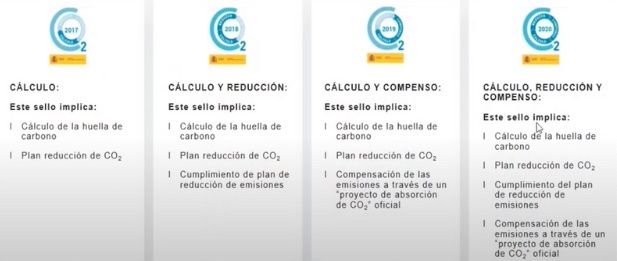
Image: Different levels of registration that a company can achieve— see MITECO document
4. Public Sector and Public Procurement: Green Procurement
Spanish regulations allow for and promote the inclusion of environmental criteria, emissions reduction, and carbon footprint considerations in public procurement. This does not mean that all public contracts require a carbon footprint assessment, but it does mean that it is increasingly common to find references to sustainability, emissions, energy efficiency, environmental plans, or reduction commitments in the bid documents.
For a company that bids on public sector contracts, having a calculated carbon footprint, a reduction plan, and—where applicable—recognized registration or certification can help it better meet the requirements of certain bid specifications. However, the specific advantage will always depend on the requirements of each individual bid.
Therefore, it should not be stated that registration with MITECO automatically grants points in all competitive bidding processes. The correct approach is to indicate that it may serve as environmental evidence when the bidding documents allow it, along with other valid forms of evidence.
Note: According to Law 9/2017 on Public Sector Contracts, government agencies may include environmental criteria related to emissions, sustainability, or carbon footprint when such criteria are relevant to the subject matter of the contract and are adequately defined in the bid specifications. Having a calculated carbon footprint, a reduction plan, or a recognized certification can add value when the contract specifications allow for it, but it does not automatically award points in all procedures.
Specific Obligations for Certain State Public Sector Entities
Royal Decree 214/2025 establishes specific obligations for certain entities in the state administrative sector. These entities must calculate their carbon footprint, develop a reduction plan, and submit this information annually to the MITECO Registry.
The first mandatory reporting is due in 2026 and covers the carbon footprint for the year 2025. This requirement applies, among others, to ministerial departments of the General State Administration, autonomous agencies, Social Security management entities and shared services, as well as other entities in the state public administration sector included within the scope of the Royal Decree.
These entities start with Scope 1 and Scope 2. Beginning with the carbon footprint for the year 2028, they must also include Scope 3, as required by the standard. This may gradually increase the demand for environmental information from suppliers, although it does not mean that all government suppliers are automatically required by law to calculate their own carbon footprint for all contracts.
The practical recommendation for public-sector suppliers is to plan ahead: calculate at least Scope 1 and 2 emissions, prepare a simple reduction plan, and keep records of the data used. Starting in 2028, consider calculating Scope 3 emissions.
5. Be mindful of regional regulations
In addition to national regulations, some autonomous communities have developed their own laws, registries, or instruments related to climate change, the energy transition, carbon footprints, or reduction plans.
This means that a company must review not only federal regulations but also state regulations that may apply to it based on its headquarters, business locations, activities, size, energy consumption, or participation in public contracts and grants.
In some regions, such as the Balearic Islands and the Valencian Community, there are specific regional frameworks regarding climate change and the ecological transition. In other regions, there may be obligations related to large energy consumers, sustainability plans, energy efficiency, green public procurement, or regional registries.
Some Autonomous Communities, for example, have stricter laws:
- Balearic Islands (Law 10/2019): Mandatory for companies with more than 50 employees or annual revenue > of 10M€.
- Valencian Community (Law 6/2022): Gradual implementation of mandatory registration. See the cases.
- Andalusia and the Canary Islands: Obligations are imposed on large energy consumers. Andalusia also offers a dual registration system—regional and national.
6. What the company should not promise: precautions to avoid mistakes and greenwashing
Calculating a carbon footprint does not mean that a company is automatically sustainable, carbon-neutral, or climate-responsible.
To communicate effectively, especially with suppliers and customers, it is best to avoid using absolute terms unless they are sufficiently substantiated.
It is better to say:
- “We’ve calculated our carbon footprint.”
- “We have developed a reduction plan.”
- “We are working to reduce our emissions.”
- “We have voluntarily registered our footprint with the MITECO Registry,” if applicable.
- “We have offset a portion of our emissions,” if applicable and traceability is available.
It is advisable to avoid statements such as “zero-emissions company,” “carbon-neutral company,” or “impact-free activity” unless there is a solid technical, legal, and documentary basis for them.
7. Sources and Regulatory Framework
This guide is based, among others, on the following standards and reference frameworks:
- Regulation (EU) 2021/1119, European Climate Law.
- Directive (EU) 2022/2464, Corporate Sustainability Reporting Directive (CSRD).
- European Sustainability Reporting Standards (ESRS).
- Law 7/2021 on Climate Change and Energy Transition.
- Royal Decree 214/2025, which creates the Registry of Carbon Footprints, Offsets, and Carbon Dioxide Absorption Projects and establishes the obligation for affected organizations to calculate, publish, and implement reduction plans.
- Law 11/2018, regarding non-financial information and diversity, to the extent that it remains applicable or has been amended or replaced by sustainability reporting regulations.
- Commercial Code and the Capital Companies Act, as they relate to sustainability information or non-financial information.
- Law 9/2017 on Public Sector Contracts.
- Applicable regional regulations regarding climate change, the energy transition, carbon footprint registries, and green public procurement.
- MITECO: (Ministry for Ecological Transition and the Demographic Challenge) - Carbon footprint registry, carbon offsets, and carbon dioxide sequestration projects
- MITECO: Annual activity report of the registry detailing trends in the number of companies that register
Note: Royal Decree 163/2014 should be cited only as historical background, as it has been repealed by Royal Decree 214/2025. Registrations made under the previous regime remain valid unless they must be updated in accordance with the new framework.
Available standards (non-exhaustive list)
GHG Protocol – Corporate Standard: Used to inventory an organization’s Scope 1, 2, and 3 emissions. It is a widely used international standard and can serve as a starting point for collecting data, defining organizational boundaries, and establishing a baseline. It does not issue a “GHG seal,” although the inventory can be externally verified. Voluntary external verification (no GHG “seal”). eur-lex.europa.eu
ISO 14064-1, ISO 14064-2, and ISO 14064-3
These standards enable the quantification, reporting, validation, and verification of greenhouse gas emissions. These standards are particularly useful when an organization wants to turn its inventory into an auditable system and enhance its credibility with customers, government agencies, or financial institutions. They can be certified by accredited bodies. eur-lex.europa.eu
ISO 14067: Focuses on the carbon footprint of a product or service. It is useful for organizations that need to calculate the environmental impacts of specific products, prepare environmental statements, respond to customers, or compare improvements between different versions of a product.
ISO 14068-1: Establishes requirements for making more credible carbon-neutrality claims and avoiding weak or difficult-to-trace environmental claims.
ISO/TR 14069: Practical Guide for Implementing ISO 14064-1 in Organizations: defines steps, boundaries, and sector-specific examples. It serves as a methodological “bridge” between the GHG Protocol and ISO 14064-1 certification. It facilitates the transition to formal verification. It is not certifiable (it is a technical report), but it supports the ISO 14064 audit. iso.org
ISO 20121: Sustainable Event Management System. For trade shows, conferences, and hackathons—whether online or hybrid/in-person. Reduces environmental impacts and attracts responsible sponsorships. Certifiable. eur-lex.europa.eu.
ISO 14046: Corporate or product water footprint. Sectors with high water consumption (agriculture, textiles). Holistic approach to sustainability. Certifiable by an accredited body
Important Notice
This guide is intended for informational and educational purposes. Regulations regarding sustainability, carbon footprints, corporate disclosure, and public procurement are evolving rapidly, particularly due to changes resulting from the CSRD, the ESRS, and the European regulatory simplification package, as well as legislative and procedural changes at MITECO. Therefore, before making any legal, corporate, or reporting decisions, each company should verify its specific situation by seeking specialized advice.
This participation does not imply any legal or technical endorsement by the European Commission of the content, services, or criteria in this guide. It represents our commitment to contributing to awareness-raising, social mobilization, and responsible climate action within a collaborative ecosystem aligned with European and global climate goals. The Carbon Footprint Association, a Partner of the European Climate Pact
The Carbon Footprint Association has been a partner in the European Climate Pact community since 2026,(see profile on the European Union website), reinforcing our commitment to climate awareness, free training, and practical action to help businesses, organizations, government agencies, and the public understand, measure, and reduce their carbon footprint.
The European Climate Pact is an initiative of the European Commission linked to the European Green Deal that encourages the participation of individuals, communities, and organizations committed to climate action in Europe.
This participation does not imply any legal or technical endorsement by the European Commission of the content, services, or criteria in this guide. It represents our commitment to contributing to outreach, social mobilization, and responsible climate action that creates a collaborative ecosystem aligned with European and global climate goals.
Other links of interest published by the Carbon Footprint Association
If you're interested in the processes related to carbon footprints and their registration with MITECO, you can find information on how the AHC selflessly helps companies complete the process at these links. Thank you
-
Change your carbon footprint! - Discover the benefits that the Carbon Footprint Association helps you to obtain.
-
We help you with MITECO Registration for free
-
MITECO Registration Assistance: we help you to carry out the complete project
-
Definitive Guide 2026: How to Register your Entity's Carbon Footprint with MITECO Step by Step
-
Courses for: Organizations: Learning to Manage Your Carbon Footprint – First Steps Toward Sustainability

